
“14% of driver time is lost in the last 2% of the journey.”
The brain has two modes for finding things. We've been forcing the slow one.
Sequential reading
Letter by letter, word by word. ~250ms per word, single-threaded. Worse in dim light, in a second language, with cluttered fonts. This is what every thermal shipping label asks of a courier.
Parallel pattern recognition
The pre-attentive visual system processes the entire field at once — colour, shape, orientation. ~200ms total, regardless of how many items are in view. It doesn't care what language the courier reads in.
Find the matching parcel. Try it in glyphs, then in text.
Same task, same answer set, same number of cards. The only thing that changes is how the parcel is labelled. Names and addresses are Singapore-flavoured on purpose — Grab's courier base reads in many languages, and the shipping label rarely matches the one they're fastest in.





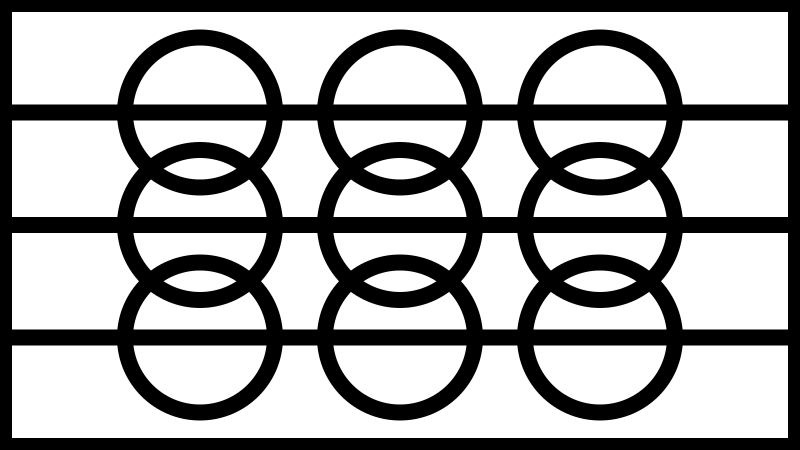








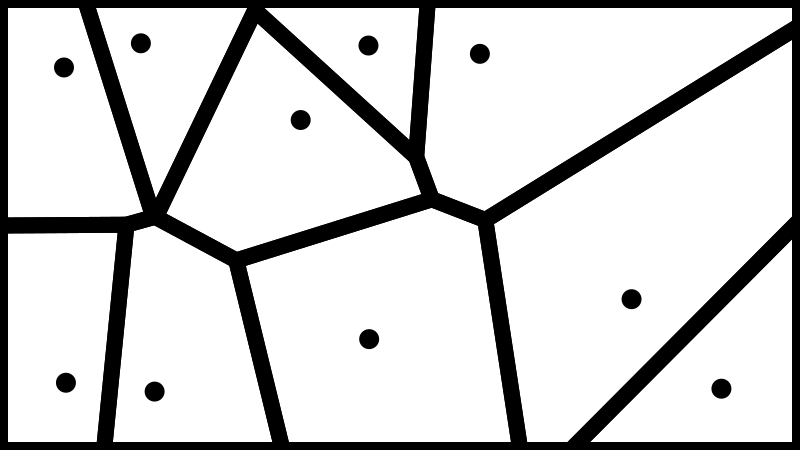


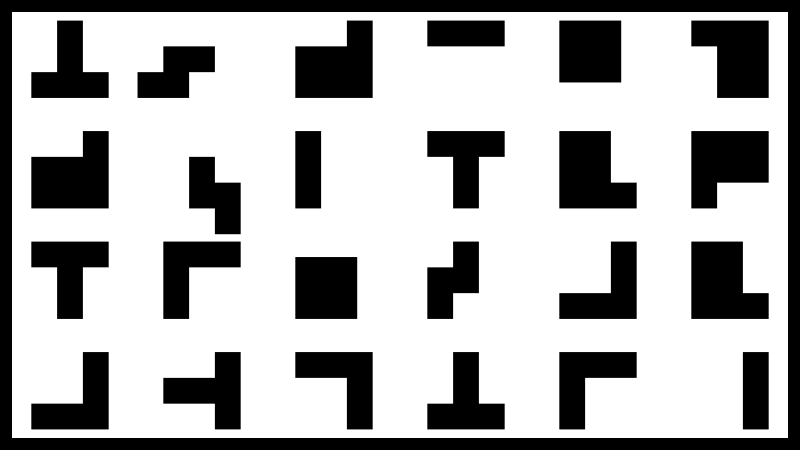
Aggregate from live trials: image matching ~1.5–2.0s (σ ~0.7s) vs text matching ~6.5–8.0s (σ ~3.5–5s). ~4× faster, ~5× lower variance.

And the gap widens in real-world conditions.
The experiment ran on a screen, in a quiet room, with high-contrast labels at full size. A delivery driver gets none of those. Here's what the actual job looks like — courier in Zagreb, parked van, dozens of near-identical brown boxes, one shipping label per parcel, no sort key but the address text.


Watch what happens to each label as those conditions stack up.
Six feet from the parcel. The courier glances at the pile — they don't walk up to read it.
Parcels land in the van at every angle. The label rotates with the box.
Half-buried under the next bag. Text matches by prefix — and the prefix is gone.
Thermal ink, ten minutes in the rain. Letters bleed first; bold shapes survive.
Why the glyph keeps working: it's holographic — like an optical hologram, every fragment of the shape carries enough of the whole that the visual system can commit. A corner, a strip across the middle, a half-smudged silhouette: any of them is enough. Text doesn't have that property. Lose a letter and the word collapses into its neighbours; lose the prefix and the sort key is gone.
Ten seconds × four and a half million pickups.
One layer at a time. Start with the most defensible: time on the clock that the fleet already spends, every day, doing the slow version of this task.
FY2025 estimate, group-wide. GrabFood + GrabMart + GrabExpress.
Conservative anchor. Field conditions push this higher; we model the floor.
45,000,000 seconds, every day, that the fleet already spends sorting.
▸ How we got to 4.5M pickups / day
We round down to 4.5M as the planning anchor — the conservative side of the AOV range.
- GMV
- — Gross Merchandise Value — total $ value of all transactions.
- AOV
- — Average Order Value — average $ per single order.
| AOV | Pickups / day |
|---|---|
| $6 | 6.4M |
| $8 | 4.8M ← used |
| $10 | 3.8M |
35M Deliveries MTUs estimate × 4 orders/mo estimate ÷ 30 ≈ 4.6M/day.
Two independent paths land in the same place. Group MTU (50M, disclosed) × Deliveries share is the base for the 35M figure.
At a blended $2.50/hour, those hours have a price tag.
Carries forward from Layer 1.
SEA driver effective take-home, blended across markets and service lines.
$31,250 every day. Annualises to $11.4M.
▸ How we got to $31k / day
Annualises to $11.4M (× 365). Reads as direct cost: time the fleet is paid for that they no longer have to spend on the slow version of the task.
- Blended hourly rate
- — Pretentive estimate of effective take-home per active hour, averaged across SG / MY / ID / VN / PH / TH and across food / mart / express. Grab does not disclose a unit driver-cost figure; this number is what we'd defend in a working session, not a published metric.
| Rate | $ / day | $ / year |
|---|---|---|
| $2.00 | $25k | $9.1M |
| $2.50 ← | $31k | $11.4M |
| $3.00 | $38k | $13.7M |
| $4.00 | $50k | $18.3M |
Even at the floor of the rate range, the daily figure is well into six digits and the annual figure crosses $9.1M.
That's 521 driver-days recovered every day at a 24-hour clock — or 1,563 equivalent working-day shifts. Time the fleet doesn't have to be paid to do, or capacity that becomes available for one more order.
4,500,000 × 10s ÷ 3,600 = 12,500 hrs/day · ÷ 24h = 521 driver-days
The seconds are the part we can model. The rest moves the same direction.
Fewer pickup errors
The glyph is a second sort key. Confusing Tan Wei Lin for Tan Wei Jian is one missed letter; confusing a triangle for a circle isn't a mistake the visual system makes. Wrong-bag handoffs drop, and so do the refunds, redeliveries, and support tickets behind them.
Happier drivers
More completed orders per shift is the metric drivers actually optimise — that's tips, surge bonuses, and faster cash-out. The pickup queue is the part of the job they hate most; we hand them back ten seconds of every one of them.
Calmer merchant counters
No more sifting through ten identical white bags at lunch peak. Staff hand the right parcel to the right courier on the first try. Less floor congestion, less store-side dwell, fewer angry phone calls about a swapped order.
Happier customers
Faster end-to-end. And at shared drop-points — condo lobbies, office reception, the front desk at a co-living block — the resident finds their bag in seconds, not minutes. The last 30 seconds of the journey, the part the customer actually feels, gets cleaner too.
No new hardware. One glyph added to the existing order slip.
[ TBD: merchant IM device thermal printer, existing Grab Driver app, single SVG glyph slot added to the existing order-slip template. Grab owns every layer. ]
What 15 seconds per pickup is worth.
[ TBD: sliders for seconds_saved + fleet size. Throughput unlock = seconds_saved / 900. Group-annualised GMV capacity = $13.9B × throughput_unlock. EBITDA = ×2.2%. ]
Jaya Grocer Singapore. 4 weeks. 100 drivers. 2 stores.
[ TBD: A/B vs control, success metrics, timeline. The wedge: Grab owns the merchant, the IM device firmware, and the Grab Driver app. The pilot is a fully internal change — Anthony can approve it in the room. ]
Read the full proposal →The same trick works for Shopper.
[ TBD: brief — Shopper is Grab's in-app picking list for retail employees walking grocery aisles. Pre-attentive labels on shelf SKUs are the obvious next product once the pickup-counter pilot proves out. One slide, no over-development. ]
30 minutes with the GrabMart ops team.
[ TBD: contact CTA, calendar link. ]